

The emergence of China as a Superpower

In wake of the recent geopolitical scenarios, China seems to be at the final stage of becoming a declared Superpower. China’s economic, military, and technological capacity have proved its metal. It is now apparent that the dynamics of our world are once again shifting from unipolar to bipolar.
Although for the term ‘Superpower’ has no agreed definition and may differ in perception, however a generally accepted definition of a superpower; is a nation that masters seven dimensions of state power; geography, population, economy, resources, military, diplomacy, and national identity.
What made the world bipolar?
With the end of World War II, emerged new conflicts, new alliances were formed. Many countries especially in Europe were compelled to join either the Russian bloc former (USSR) or the United States of America bloc.
USSR came out of World War II as triumphant, with a large territorial gain by defeating Nazi Germany took control of many countries of Eastern Europe, having high prestige of defeating Hitler and a huge arsenal with big weaponry and manpower. After the war, the USSR started to re-build its economy with the complex nature of a communism based economic system where everything was owned by the state, the system experienced a rapid economic growth that added might to the USSR. An amalgamation of all this declared it as an emerging superpower.
The United States too came out of World War II victorious, having comparatively fewer losses. It’s Military rejuvenated fairly quickly and having the edge of being the only nuclear power until 1949. The American economy was vibrant. The military technology and superiority of the United States were unmatched. The vibrant economy made the United States grow exponentially, industrialization, Agricultural technology, and oil exploration made the United States of America a superpower with a soft face towards the world the United States also became the land of opportunities for the rest of the citizens of the world.
In the bipolar world, divided into 2 power centers started economic and geographic tussles there was a reign of fear and deep uncertainty, the world seemed to be at the verge of another global-scale conflict, both the superpowers dumped massive chunks of theirs budgets in the development of modern weapons, USSR developed a nuclear weapon and in August 1949 conducted its first test. The path of this nuclear weapons race was opted by other emerging powers followed by the UK in 1952, France in 1960, and subsequently China in 1964 later Israel, Indian, and Pakistan joined the nuclear club.
This state of global geopolitical tensions starting from the post WW2 era was first termed by an English writer George Orwell. The first use of the term to describe the specific post-war geopolitical confrontation between the Soviet Union and the United States came in a speech by Bernard Baruch, an influential advisor to the U.S. presidents.
The era of cold war starting from 1947 till 1991 was the time when not only the development of conventional and nuclear arsenals was on the rise but new techniques were acquired for dominance, espionage, proxy wars, propaganda campaigns, economic embargos even the sports and race to space research all was revolving around the rivalry and the ideological and geopolitical struggle for global influence by the two powers.
This blind passion for global influence ended until the rise of the USSR turned into a fall. The dissolution of USSR was a result of internal disintegration within the Union of Soviet Socialist Republics and finally, in 1991, the Supreme Soviet voted the USSR itself out of existence.
The Unipolar World
The world became unipolar, The United States of America as a superpower dominating and influencing the world. All the weapons and techniques it developed during the era of the cold war the U.S. spread its tentacles around the world, rising of new global conflicts, and more complex geopolitical alignments were witnessed. Terrorism and proxy wars were on the rise. The footprint of The U.S. was found in every global conflict from Iraq to Afghanistan. The direct military presence of the United States in the influential oil-rich state of the Middle-East KSA, Qatar, Kuwait, and UAE. The Americans took advantage of all the Arab world’s fault lines, fuelled wars and let them destroy each other to the benefit of Israel and its plan of making greater Israel. The U.S. invaded Iraq and fought an 8 years’ war and still having its troops in Iraq. A similar attack was launched in Afghanistan to fight terrorism and Al-Qaeda which allegedly launched terrorist attacks in the U.S. The 18 years old war is now about to conclude with a peace deal with the Taliban followed by partial withdrawal of the US and NATO forces.
The western allies of the U.S. that formed an organization in the cold war era the NATO, it is steadily helping the U.S. sustain its global hegemony despite some fundamental changes they have made to their constitution they keep supporting the U.S. policy.
In simpler terms, the claims of the United States for making a peaceful world is an illusion, it has created to sustain its global hegemony.
Rise of China as Superpower
Modern China’s (1949–2020)
While USSR and the United States were busy in their struggle of power. From the debris of the Chinese Civil War, Japan’s Military occupation and WW2 rose a nation lead by Mao Zedong the Chinese Communist Party took absolute control of China, ended extraterritoriality of colonial powers, all the westerners were expelled from China as the government began the long, and often tumultuous, task of transforming the once great, but now shattered, country.
Economy
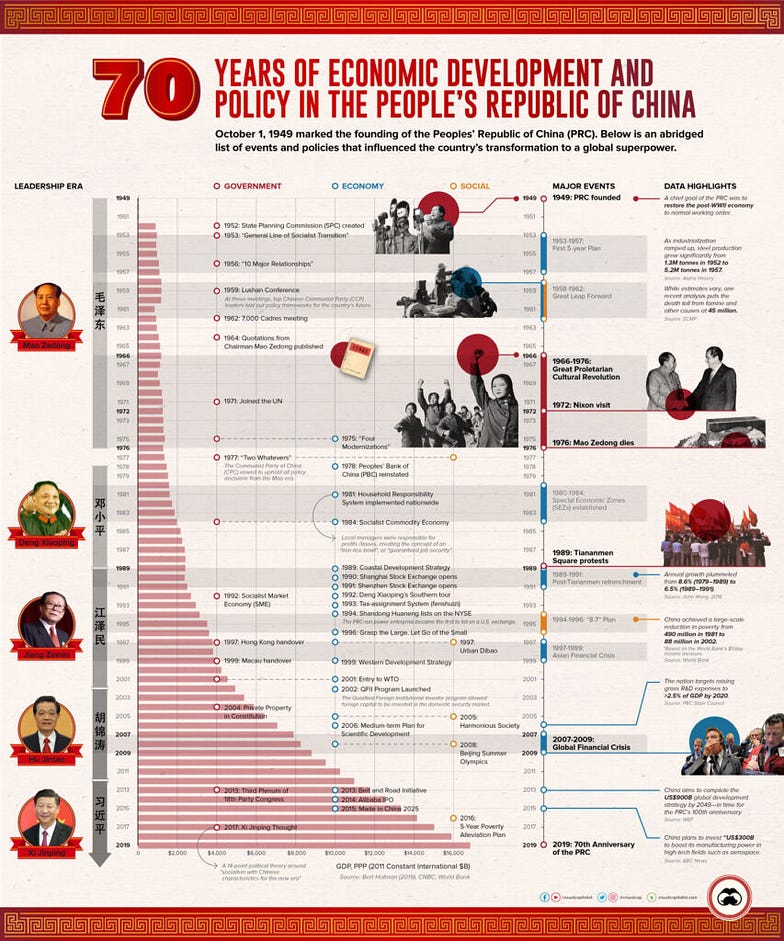
The new social and economic reforms began, the economic reforms were flexible and helped the Chinese government to overcome the survival issues. China consistently followed its path of economic growth with massive industrialization, strengthening of the local economy, building massive infrastructure, and smart management of its human resource backed by a huge population, cheap labour and enormous natural resources enabled China to grow into the second-largest economy of the world.
The image below is a one page summary of 70 years of Chinese economic growth:
Military
China’s national military strategy seeks to achieve three sets of national military objectives: Protect the Party and Safeguard Stability, Defend Sovereignty and Defeat Aggression, and modernize the Military and Build the Nation.
The People’s Liberation Army (PLA) is the armed forces of the People’s Republic of China (PRC) and its founding and ruling political party, the Communist Party of China (CPC). The PLA consists of five professional service branches: the Ground Force, Navy, Air Force, Rocket Force, and the Strategic Support Force. Units around the country are assigned to one of five theatre commands by geographical location. The PLA is the world’s largest military force and constitutes the second-largest defense budget in the world. The PLA is one of the fastest modernizing militaries in the world and has been termed as a potential military superpower, with significant regional power and rising global power projection capabilities.
Implications of China-US Economic feud and the recent escalation
China’s growing global economic influence and the economic and trade policies it maintains, have significant implications for the United States and hence are of major interest to Congress. While China is a large and growing market for U.S. firms, its incomplete transition to a free-market economy has resulted in economic policies believed to be harmful to U.S. economic interests.
The latest economic rift between China and The U.S. started in 2018 when the U.S. President Trump signed a memorandum instructing the Untied State Trade Representative to apply $50 billion tariffs on the goods being imported into the U.S. as part of his America First policy, the target of this policy was to narrow down the trade deficits. The tariffs were applied to goods from The E.U., Canada and Mexico. In another move, the Trump administration imposed escalated tariffs on goods being imported from China that started an economic war.
China in retaliation imposed $34 billion trade tariffs on U.S. goods. Whereas the other U.S. trade partners also imposed trade tariffs on U.S. goods.
During this tariff war, a New York court ordered arrest warrant for the chief executive of Chinese telecom equipment company Huawei Technologies, Meng Wanzhou, as it is believed that Meng covered up attempts by Huawei-linked companies to sell equipment to Iran, breaking U.S. sanctions against the country.
Until 2019 both countries kept on imposing trade tariffs on goods being traded between them. In a new development in Oct 2019 U.S. commerce department puts 28 Chinese companies on its “entity list,” restricting the sale of U.S. goods and technology to them over their alleged involvement in human rights abuses against Uighur Muslims in Xinjiang. China warned the United States should stop interfering in its affairs.
In January 2020 Corona outbreak in Wuhan started, the U.S. and other countries imposed a travel ban to and from China.
In June 2020 Chinese President Xi Jinping signed the security law. It has been added to Hong Kong’s Basic Law, the 50-year mini-constitution agreed when the territory’s sovereignty was returned to China by the UK in 1997. The new law gives Beijing jurisdiction over “very serious” national security crimes, with offenders facing up to life in prison. The law also empowers China to set up a national security agency in the city with staffers from mainland China. Security agencies of China will also be able to operate publicly in the city for the first time, unbound by local laws as they carry out their duties.
U.S. President took the Hong Kong legalisation of China serious, termed it as a tragedy, Further the U.S. Secretary of State Mike Pompeo called Hong Kong law an insult to all nations and said Washington will pursue Trump’s directive to end the territory’s special status.
The U.S. Rejection of the Chinese claims of South china seas is another clear provocation to China. U.S. posture takes direct aim at many of the legally questionable claims that China has used for years to attempt to establish ownership of the vast majority of the South China Sea.
China called the Pompeo statement “despicable” and accused the United States of making the statement as a “prelude to inciting more confrontations.”
“China has sovereignty and jurisdiction over the South China Sea in accordance with international law, including the United Nations Convention on the Law of the Sea, and China also has historical rights in the South China Sea,”
In a recent development diplomatic ties of U.S. and China also got worst when both, China and the U.S. closed one of each other’s consulates.
Conclusion
In the present situation when the U.S. Navy is patrolling the region around the South China Sea and provided the delicacy of the situation it can anytime slide towards a direct military confrontation between China and U.S. this will have a direct effect on the global peace and security.
China’s BRI (Belt and Road Initiative) is not only a regional road network, it is a transcontinental long-term policy and investment program which aims at infrastructure development and acceleration of the economic integration of countries along the route of the historic Silk Road.
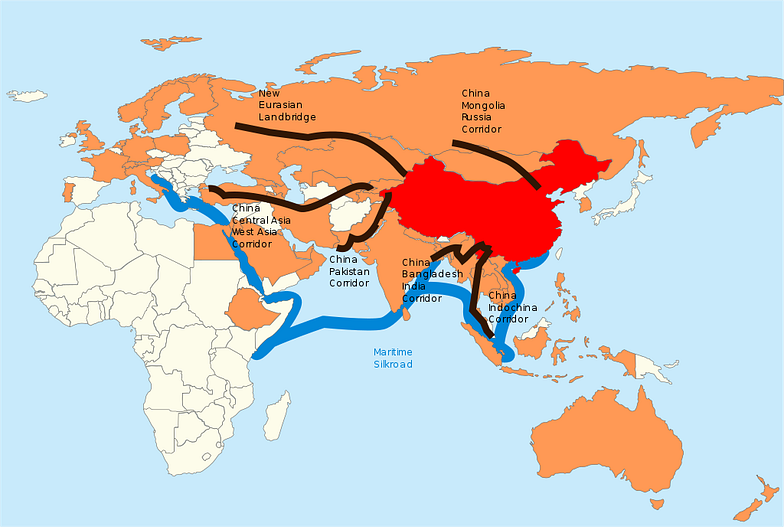
As of now, 71 countries are taking part in the BRI (Belt and Road Initiative), together representing more than a third of the world`s GDP and two-thirds of the world`s population.
We have reasons to believe that the Chinese dragon will overcome these crises because of its strong diplomatic and business influences in the region and globally. Its leadership is poised and has calm.
The present escalation by the U.S. can also be perceived as a deliberate move to curtail Chinese growing global economic influence. The Chinese global economic plans are based on territorial respect, contrary to the U.S. behavior of global political manipulation and disrespect to the sovereignty of many nations by either directly attacking them or through proxy wars.
Recent India — China conflict is not in any way a threat to China, despite the U.S. support to India, for becoming a regional superpower. Indian efforts of becoming a regional superpower and coming parallel to China is nothing but a delusion.
With china’s strong position as an emerging superpower, the world may not remain unipolar anymore and the U.S. hegemony will gradually end.
In the worst-case scenario, the present situation may turn into another ugly global scale war that may change the world forever.


